• open navigation menu
  • Logo
    • Input keywords/ Part number
    • Manufacturers
    • Hot Products
    • RFQ
    • Blog
    • Tools
    • About Us
    • Quality Control
    Logo

    Sale support

    • info@glofell.com

    Company

    • Blog
    • About Us
    • Quality Control
    • Contact Us

    Resource

    • Categories
    • Manufacturers
    • Tools

    Quick link

    • Privacy Policy
    • Terms & Conditions
    • Cookies Policy
    • Refund & Return Policy
    • Shipping & Delivery Policy

    © 2026 Copyright. All Rights Reserved. Made by Glofell

    Payment
    Payment
    Payment
    Payment
    1. Home/
    2. Tools/
    3. LED Series Resistor Calculator

    LED Series Resistor Calculator

    Glofell's LED Series Resistor Calculator helps you find the current-limiting resistor needed to safely drive one or more LEDs. Enter the supply voltage, LED forward voltage, and operating current to get the recommended resistance and minimum power rating. For reliable operation and reduced heat, choose a resistor rated two to ten times above the calculated value.

    LED Series Resistor Calculator

    V
    V
    mA
    =
    Ω
    =
    W

    Formula

    LED series diagram
    LED series table

    Introduction

    How to Calculate the Resistor Value for an LED Series Circuit

    Every Light-Emitting Diode (LED) has a maximum current limit. Exceeding this limit, even briefly, can permanently damage the LED. Therefore, using a series resistor to limit current is a standard and essential practice.

    Note: This resistive method is best for low-power indicator LEDs. High-power LEDs (like those used in lighting) typically require a dedicated switching current regulator.

    The Formula: Ohm's Law for LEDs

    To calculate the required resistance, simply subtract the LED's forward voltage from the power supply voltage, then divide by the desired current.

    R=VS−VFIFR = \frac{V_S - V_F}{I_F}R=IF​VS​

    Where:

    • RRR: Resistance value (in Ohms, Ω\OmegaΩ).
    • VSV_SVS​: Supply Voltage. The voltage of your power source (e.g., 5V, 9V, 12V).
    • VFV_FV: . The voltage drop across the LED (see table below).

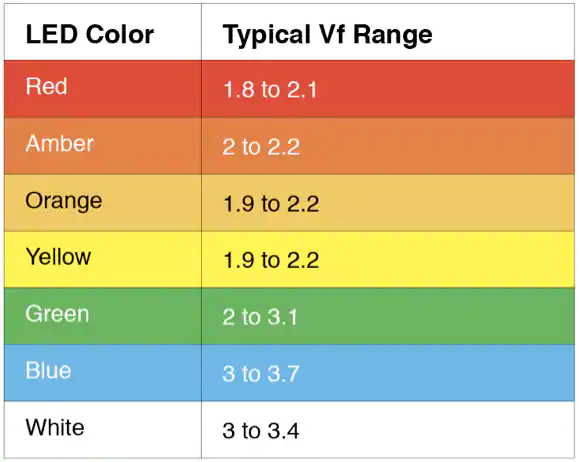
    Reference: Standard LED Forward Voltages (VFV_FVF​)

    The voltage drop across an LED depends on the semiconductor material used to produce its color.

    LED ColorTypical Voltage Drop (VFV_FVF​)
    Infrared1.2V - 1.6V
    Red1.8V - 2.2V
    Orange / Amber2.0V - 2.2V
    Yellow2.0V - 2.4V
    Green2.0V - 3.0V
    Blue3.0V - 3.4V
    White3.0V - 3.6V
    −
    VF​
    ​
    F
    ​
    Forward Voltage
  • IFI_FIF​: Forward Current. The current you want flowing through the LED.
    • Tip: Typical 3mm and 5mm LEDs operate between 10mA to 30mA. If you don't have the datasheet, 20mA (0.02A) is a safe standard value.
  • FAQ

    How do you calculate the resistor for LEDs in series?

    For LEDs in series, multiply the forward voltage of one LED by the total number of LEDs to get the total voltage drop. Subtract that from the supply voltage, then divide by the desired LED current. The result is the required series resistance.

    What size resistor do I need for an LED?

    Check the LED datasheet for its forward voltage and recommended current (typically 10 to 20 mA). For example, an ultra-bright blue LED with a 9V battery may have a forward voltage of 3.2V and a typical current of 20mA. The required resistor would be (9V - 3.2V) / 0.02A = 290 ohms, so choose the closest available standard value.

    Do you need a resistor for each LED?

    In most cases, yes. An LED is a current-driven component, and a series resistor (often called a ballast resistor) sets the operating current. If the supply voltage exactly equals the LED's forward voltage and the supply is current-limited, a resistor may not be required. Otherwise, each LED or series string should have its own current-limiting resistor.

    How do I connect 220 volts to an LED?

    You can operate an LED from 220V AC by placing a capacitor in series to limit the current; unlike a resistor, the capacitor does not heat up significantly. A Zener diode is often added to protect the LED from high voltage. During the positive half-cycle, the Zener clamps the LED and series resistor to about 2.7 volts.

    What happens if you don't use a resistor with an LED?

    Connecting an LED directly to a voltage source without a current-limiting resistor allows too much current to flow. The LED may appear very bright for a short time, but it will quickly overheat and burn out.

    What voltage do LEDs use?

    The forward voltage of an LED typically ranges from 1.8V to 3.3V, depending on its color. A red LED usually drops around 1.7–2.0V, while a blue or white LED may drop about 3.0–3.3V because the voltage drop increases with the band gap energy.

    Should the resistor go before or after the LED?

    It doesn't matter electrically. The resistor can be placed on either side of the LED in a series circuit because the current flowing through the circuit is the same, so the LED remains protected.

    How do I calculate resistance?

    If you know the total current and the applied voltage, use Ohm's Law: R = V / I. For example, if a circuit has 9 volts across it and a total current of 3 amps, the total resistance is 9V / 3A = 3 ohms.

    How do I know what voltage my LED is?

    The most reliable method is to check the LED datasheet. You can also measure the forward voltage with a multimeter using the diode test function, or connect the LED in series with a battery and a potentiometer. Start with a high resistance and slowly decrease it until the LED reaches a comfortable brightness; the voltage across the LED at that point is its approximate forward voltage.

    What resistor do I need to reduce voltage?

    To reduce a voltage by half, create a voltage divider using two resistors of equal value in series, for example two 10 kΩ resistors. The output taken between the two resistors will be half the input voltage.

    Related Tools
    Resistor Color Code Calculator

    Resistor Color Code Calculator

    106

    Glofell’s Resistor Color Code Calculator decodes 4-band, 5-band, and 6-band resistors. Select each band to identify resistance, tolerance, and power rating for circuit work, repairs, or lab sorting.

    Ohms Law Calculator

    Ohms Law Calculator

    94

    Glofell’s Ohm’s Law Calculator helps engineers and students quickly solve for voltage, current, resistance, and power. Provide any two known values to calculate the remaining parameters, making it a practical reference for circuit design, troubleshooting, and electronics learning.

    Op-Amp Voltage and Gain Calculator

    Op-Amp Voltage and Gain Calculator

    86

    Calculate output voltage together with inverting and non-inverting gain for operational-amplifier circuits. Enter V1, V2, Vp, Vn, and resistor values R1 through R4 to obtain accurate results for circuit design, troubleshooting, and op-amp learning.

    Inverting Op-Amp Resistor Calculator

    Inverting Op-Amp Resistor Calculator

    87

    Analyze an inverting operational-amplifier circuit by entering the desired gain, output voltage (Vout), R1 resistance, and input voltages V1, V2, Vp, and Vn. The calculator automatically determines the required R2, R3, and R4 resistor values, helping you design and verify inverting op-amp configurations.

    Hot Products
    02-N101-1
    02-N101-1
    Unknown
    HOT
    A03402
    A03402
    AOS
    HOT
    A4911KJPTR-T-1
    A4911KJPTR-T-1
    Allegro
    HOT
    ACS711ELCTR-12AB-T
    ACS711ELCTR-12AB-T
    Allegro
    HOT
    A333
    A333
    Allwinner
    HOT
    T113-S3
    T113-S3
    Allwinner
    NEW
    10M04SCU324C8G
    10M04SCU324C8G
    Altera
    NEW
    AD8656ARZ-REEL7
    AD8656ARZ-REEL7
    Analog Devices
    HOT
    ADA4932-1YCPZ-R7
    ADA4932-1YCPZ-R7
    Analog Devices
    HOT
    ADG453BRZ-REEL7
    ADG453BRZ-REEL7
    Analog Devices
    BEST SELL
    ACPL-P343-500E
    ACPL-P343-500E
    Broadcom
    HOT
    AEDR-8710-100
    AEDR-8710-100
    Broadcom