• open navigation menu
  • Logo
    • Input keywords/ Part number
    • Manufacturers
    • Hot Products
    • RFQ
    • Blog
    • Tools
    • About Us
    • Quality Control
    Logo

    Sale support

    • info@glofell.com

    Company

    • Blog
    • About Us
    • Quality Control
    • Contact Us

    Resource

    • Categories
    • Manufacturers
    • Tools

    Quick link

    • Privacy Policy
    • Terms & Conditions
    • Cookies Policy
    • Refund & Return Policy
    • Shipping & Delivery Policy

    © 2026 Copyright. All Rights Reserved. Made by Glofell

    Payment
    Payment
    Payment
    Payment
    1. Home/
    2. Tools/
    3. Ohm's Law Calculator

    Ohms Law Calculator

    Glofell’s Ohm’s Law Calculator helps engineers and students quickly solve for voltage, current, resistance, and power. Provide any two known values to calculate the remaining parameters, making it a practical reference for circuit design, troubleshooting, and electronics learning.
    Ohms Law Calculator

    V
    A
    Ω
    W
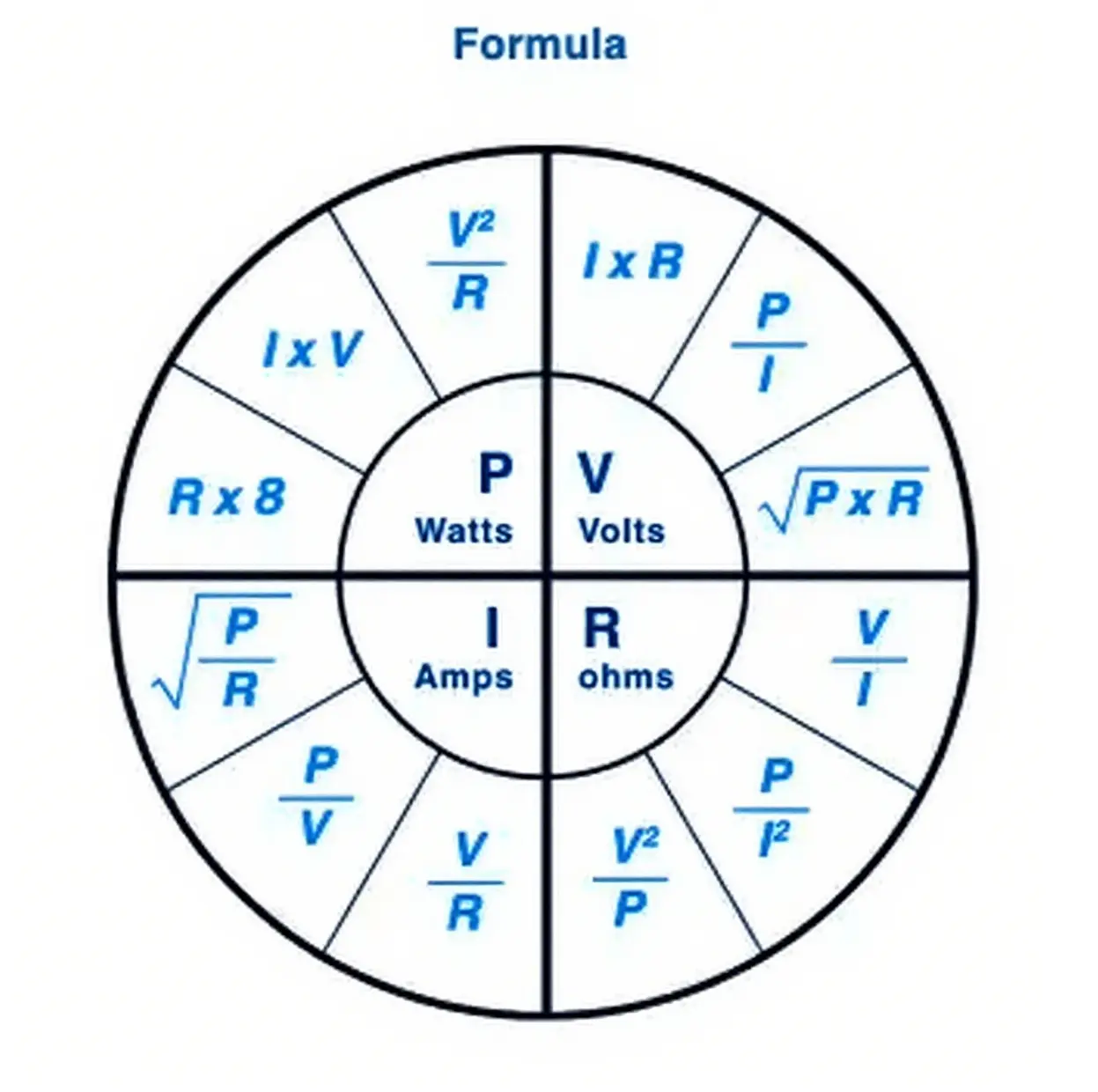
    Ohm's law formulas wheel

    Introduction

    Ohm's Law: Guide & Calculator Overview

    Introduction

    For certain conductors of electricity, the electric current passing through them is directly proportional to the voltage applied. This relationship relies on the fact that the drift velocity of charges through the material is proportional to the electric field in the conductor.

    The resistance is the ratio of voltage to current. If this ratio remains constant over a broad range of voltages, the material is considered "ohmic." If the resistance of a substance is known, the current can be predicted using the fundamental relationship known as Ohm's Law.

    Overview of Ohm's Law Calculator

    An Ohm's Law Calculator is a handy tool for determining the mathematical relationship between voltage, current, and resistance across a conductor. These formulas are fundamental in electrical engineering and electronics. Understanding how to calculate these values, along with power, is essential for analyzing electronic circuits.


    Ohm's Law Explanation

    What is Ohm's Law?

    Ohm's Law asserts that if all physical parameters (such as temperature) remain constant, the voltage across a conductor is directly proportional to the current flowing through it. Resistance (RRR) is the constant of proportionality in this equation, measured in units of ohms (Ω\OmegaΩ).

    How Does It Work?

    Ohm's Law defines how current flows through a resistance when a distinct electric potential (voltage) is applied. This is often compared to water flowing through a pipe:

    • Voltage (VVV): Represents water pressure.
    • Current (III): Represents the volume of water flowing.
    • Resistance (RRR): Represents the size of the pipe.

    Higher pressure (voltage) or a wider pipe (lower resistance) results in more water flow (current).

    Ohm's Law Formulas (DC)

    The relationship describes the link between Voltage (VVV), Current (III), and Resistance (RRR).

    1. Voltage Formula The voltage VVV in volts (VVV) is equal to the current III in amps (AAA) multiplied by the resistance RRR in ohms (Ω\OmegaΩ):

    V=I×RV = I \times RV=I×R

    2. Power Formula The power PPP in watts (WWW) is equal to the voltage VVV multiplied by the current III:

    P=V×IP = V \times IP=V×I

    3. Resistance Formula Resistance can be calculated as the quotient of voltage and current:

    R=VIR = \frac{V}{I}R=IV​

    4. Current Formula Current is equal to voltage divided by resistance:

    I=VRI = \frac{V}{R}I=RV​

    Note: Ohm's law strictly applies to ohmic materials (like metals and ceramics) under constant conditions. Non-linear devices like semiconductors and insulators may not follow this linear relationship strictly.

    AC Ohm's Law Formula

    In Alternating Current (AC) circuits, resistance is replaced by Impedance (ZZZ).

    Voltage in AC:

    V=I×ZV = I \times ZV=I×Z

    (Where ZZZ is Impedance in Ω\OmegaΩ)

    Complex Power (SSS) in Volt-Amps (VAVAVA):

    S=V×IS = V \times IS=V×I


    Visual Aids: The Triangle and The Wheel

    Ohm's Law Triangle

    The Ohm's Law Triangle is a visual tool to help remember the three main formulas. Voltage (VVV) is always at the top, with Current (III) and Resistance (RRR) at the bottom.

    • To find Resistance (RRR): Cover RRR. You see VVV over III. R=VIR = \frac{V}{I}R=IV​
    • To find Current (III): Cover III. You see VVV over RRR. I=VRI = \frac{V}{R}I=
    • To find Voltage (VVV): Cover VVV. You see III next to RRR. V=I×RV = I \times RV=I×R

    Ohm's Law Wheel (Power Wheel)

    The "Formula Wheel" combines Ohm's Law with the Power formula (P=VIP = VIP=VI) to show the relationships between Power (PPP), Current (III), Voltage (VVV), and Resistance (RRR). This creates four quadrants, each offering three formulas to solve for a specific variable.

    How to Use the Power Wheel

    1. Identify the Target: Decide which variable you need to solve for (P, R, I, or V).
    2. Identify Knowns: Determine which two variables you already know.
    3. Select Formula: Look at the quadrant for your target variable and select the formula that uses your two known variables.
    4. Solve: Plug in your numbers and calculate.

    Tip: Always ensure units are consistent (e.g., convert Milliamps to Amps or Kilohms to Ohms) before calculating.


    Practical Example

    Scenario 1: You have a 120 Volt (VVV) light bulb that draws 0.625 Amps (III) of current. What is the resistance?

    • Formula: R=VIR = \frac{V}{I}R=IV​
    • Calculation: 120/0.625=192120 / 0.625 = 192120/0.625=192
    • Result: The resistance is 192 Ω\OmegaΩ.

    Scenario 2: You know the current (III) and the filament resistance (RRR). Can you find the voltage? Yes, using the Triangle:

    • Formula: V=I×RV = I \times RV=I×R

    How to Calculate Using Ohm's Law

    You can determine the values in any circuit in three simple steps:

    1. List Known Values: Write down the variables you know (e.g., V=12VV = 12VV=12V, R=100ΩR = 100\OmegaR=100Ω).
    2. Identify Unknown: Write down the variable you need to solve for (e.g., I=?I = ?I=?).
    3. Apply Formula: Use the standard formula V=I×RV = I \times RV=I×R (or its variations) to solve.

    Definitions:

    • Current (III): The flow of electrons, measured in Amps.
    • Voltage (VVV): The electrical pressure or potential difference, measured in Volts.
    • Resistance (RRR): The opposition to current flow, measured in Ohms.

    Conclusion

    Ohm's Law is straightforward yet critical for all circuit design. By knowing just two of the three variables, you can easily determine the third. This cornerstone of electrical engineering underpins the inner workings of every circuit, from the simplest flashlight to the most complex motherboard.

    More Electronic Conversion and Calculators

    • dBm to Watts Calculator
    • BJT Cascode Amplifier Calculator
    • SMD Resistor Code Calculator
    • Resistor Color Code Calculator
    • Parallel and Series Resistor Calculator
    FAQ

    What are the 3 forms of Ohm's law?

    The three forms are V = IR, I = V/R, and R = V/I. A circle diagram can help you memorize these formulas, with V always at the top.

    What is the current formula?

    Current is usually denoted by the symbol I. Ohm's law relates the current flowing through a conductor to the voltage V and resistance R: V = IR. An alternative statement is I = V/R.

    What is Ohm's law in simple terms?

    In simple terms, Ohm's law states that the strength of a direct current is directly proportional to the potential difference and inversely proportional to the resistance of the circuit.

    How many ohms is 100 watts?

    For example, a 100-watt light bulb operating on 120 volts AC will have 144 ohms of resistance and will draw 0.833 amps.

    What is meant by 1 ohm?

    One ohm is defined as the resistance of a conductor with a potential difference of 1 volt applied to its ends while a current of 1 ampere flows through it.

    What is the wattage formula?

    The formula for calculating wattage is W = V × A, where W is watts, V is volts, and A is amperes of current. In practical terms, wattage is the power produced or used per second. For example, a 60-watt light bulb uses 60 joules per second.

    What is the relation between current and resistance?

    Ohm's law expresses the relationship between current, voltage, and resistance: the current flowing in a circuit is directly proportional to the applied voltage and inversely proportional to the resistance of the circuit, provided the temperature remains constant.

    What are the types of current?

    There are two kinds of current electricity: direct current DC and alternating current AC. With direct current, electrons move in one direction; batteries produce direct current. In alternating current, electrons flow in both directions.

    How many ohms is 40 watts?

    Using the formula R = P / I², with 40 watts and a current of 20 amps, the resistance is 40 divided by 400, which equals 0.1 ohm, or 100 milliohms.

    How many watts is a 2-ohm speaker?

    Related Tools
    Resistor Color Code Calculator

    Resistor Color Code Calculator

    106

    Glofell’s Resistor Color Code Calculator decodes 4-band, 5-band, and 6-band resistors. Select each band to identify resistance, tolerance, and power rating for circuit work, repairs, or lab sorting.

    Op-Amp Voltage and Gain Calculator

    Op-Amp Voltage and Gain Calculator

    86

    Calculate output voltage together with inverting and non-inverting gain for operational-amplifier circuits. Enter V1, V2, Vp, Vn, and resistor values R1 through R4 to obtain accurate results for circuit design, troubleshooting, and op-amp learning.

    Inverting Op-Amp Resistor Calculator
    R
    V
    ​

    With a 2-ohm speaker, the maximum output power will be 550 watts.

    Inverting Op-Amp Resistor Calculator

    87

    Analyze an inverting operational-amplifier circuit by entering the desired gain, output voltage (Vout), R1 resistance, and input voltages V1, V2, Vp, and Vn. The calculator automatically determines the required R2, R3, and R4 resistor values, helping you design and verify inverting op-amp configurations.

    Switching Regulator Design Calculator

    Switching Regulator Design Calculator

    99

    Design a switch-mode voltage regulator by calculating duty cycle, inductor value, current levels, and diode power loss. Use the results to optimize a DIY regulator circuit.

    Hot Products
    02-N101-1
    02-N101-1
    Unknown
    HOT
    A03402
    A03402
    AOS
    HOT
    A4911KJPTR-T-1
    A4911KJPTR-T-1
    Allegro
    HOT
    ACS711ELCTR-12AB-T
    ACS711ELCTR-12AB-T
    Allegro
    HOT
    A333
    A333
    Allwinner
    HOT
    T113-S3
    T113-S3
    Allwinner
    NEW
    10M04SCU324C8G
    10M04SCU324C8G
    Altera
    NEW
    AD8656ARZ-REEL7
    AD8656ARZ-REEL7
    Analog Devices
    HOT
    ADA4932-1YCPZ-R7
    ADA4932-1YCPZ-R7
    Analog Devices
    HOT
    ADG453BRZ-REEL7
    ADG453BRZ-REEL7
    Analog Devices
    BEST SELL
    ACPL-P343-500E
    ACPL-P343-500E
    Broadcom
    HOT
    AEDR-8710-100
    AEDR-8710-100
    Broadcom