Glofell’s Resistor Color Code Calculator decodes 4-band, 5-band, and 6-band resistors. Select each band to identify resistance, tolerance, and power rating for circuit work, repairs, or lab sorting.

Introduction
The Resistor Color Code Calculator is designed to instantly compute the resistance value for 4, 5, and 6-band resistors.
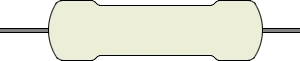
Resistors use a standardized color-coding system to indicate their resistance value, tolerance, and sometimes reliability or temperature coefficient. This is necessary because the components are often too small for printed text.
To read a resistor manually, hold it so the band closest to one end is on the left. The gap between bands is usually wider before the tolerance band (the last band on the right).
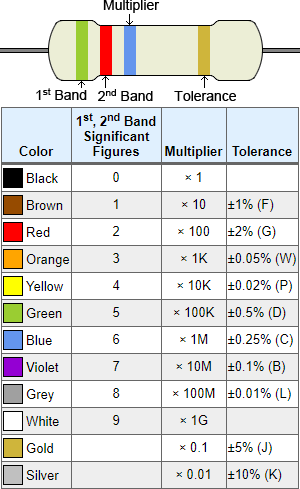
Use this table to decode the colors on your resistor:
| Color | Significant Digits | Multiplier | Tolerance | Temp. Coefficient |
|---|---|---|---|---|
| Black | 0 | 1 () | - | 250 ppm/K |
| Brown | 1 | 10 () | (F) |
This is the most common type.
Used for higher precision (1% or 2% tolerance).
High-precision resistors used in temperature-sensitive environments.
| Resistance | 4-Band Code (5% Tolerance) | 5-Band Code (1% Tolerance) |
|---|---|---|
| 1 | Brown - Black - Gold - Gold | Brown - Black - Black - Silver - Brown |
| 10 | Brown - Black - Black - Gold | Brown - Black - Black - Gold - Brown |
| 100 | Brown - Black - Brown - Gold | Brown - Black - Black - Black - Brown |
| 1 k | Brown - Black - Red - Gold | Brown - Black - Black - Brown - Brown |
| 10 k |
Resistors are manufactured in standard logarithmic values known as E-Series to verify component tolerance and reduce inventory complexity.
| 100 ppm/K |
| Red | 2 | 100 () | (G) | 50 ppm/K |
| Orange | 3 | 1k () | (W) | 15 ppm/K |
| Yellow | 4 | 10k () | (P) | 25 ppm/K |
| Green | 5 | 100k () | (D) | 20 ppm/K |
| Blue | 6 | 1M () | (C) | 10 ppm/K |
| Violet | 7 | 10M () | (B) | 5 ppm/K |
| Grey | 8 | 100M () | (L) | 1 ppm/K |
| White | 9 | 1G () | - | - |
| Gold | - | 0.1 () | (J) | - |
| Silver | - | 0.01 () | (K) | - |
| Brown - Black - Orange - Gold |
| Brown - Black - Black - Red - Brown |
| 100 k | Brown - Black - Yellow - Gold | Brown - Black - Black - Orange - Brown |
| 1 M | Brown - Black - Green - Gold | Brown - Black - Black - Yellow - Brown |
| 10 M | Brown - Black - Blue - Gold | Brown - Black - Black - Green - Brown |
Hold the resistor so the tolerance band (gold or silver) is on the right. Read the color bands from left to right and enter them into the calculator. The tool displays the resistance value and tolerance immediately.
A resistor color code is a standardized system of colored bands printed on a resistor to indicate its resistance value, tolerance, and sometimes temperature coefficient. It is used because the components are too small to have printed numbers. The concept of using colors for coded communication dates back to flag signaling systems.
A 100kΩ 4-band resistor uses the color code brown-black-yellow-gold. With a gold tolerance band, the value is 100,000Ω ±5%, so it can measure anywhere from 95kΩ to 105kΩ. To confirm, remove the resistor from the circuit and measure it with a digital multimeter in resistance mode, as measuring in-circuit can give misleading results due to parallel paths.
A 1kΩ resistor is commonly marked with four bands: brown, black, red, and gold (for 5% tolerance). The first two colors represent the digits 1 and 0, and the red band is the multiplier (×100), giving 1,000Ω. For a 1% tolerance 5-band resistor, the code is brown-black-black-brown.
A resistor is a passive component that opposes the flow of electric current. Its resistance, measured in ohms (Ω), indicates how strongly it restricts current. A higher resistor value means greater opposition to current flow.
A 3.9kΩ metal film resistor with ±1% tolerance is marked orange-white-black-brown-brown. The first three bands give 390, and the brown multiplier ×10 gives 3,900Ω.
A 100kΩ resistor (4-band) uses the color code brown-black-yellow-gold. Brown and black give 10, yellow means multiply by 10,000, and gold indicates ±5% tolerance. The result is 10 × 10,000 = 100,000Ω = 100kΩ.
A resistor is a passive electrical component with two terminals that limits or regulates the flow of electric current in a circuit. It is used to reduce current flow, adjust signal levels, and divide voltages.
A 2.2kΩ 4-band resistor is color-coded red-red-red-gold. Red (2), Red (2), Red (×100), and Gold (±5%) gives 22 × 100 = 2,200Ω = 2.2kΩ. With a 5% tolerance, the actual value lies between 2,090Ω and 2,310Ω.
A 10kΩ 4-band resistor typically shows brown-black-orange-silver (10% tolerance) or brown-black-orange-gold (5% tolerance). The first two bands represent 10, the orange band multiplies by 1,000, giving 10,000Ω. If the resistor has five bands, the code is brown-black-black-red, with the fifth band indicating tolerance.
Treat the first five bands like a 5-band resistor: three significant digits, a multiplier, and a tolerance. The sixth band indicates the temperature coefficient (ppm/°C) or reliability. Enter all six colors into the calculator and it will compute the resistance, tolerance, and temperature coefficient.
A 3-band resistor has a 20% tolerance. The first two bands are significant digits and the third is the multiplier. For example, brown-black-orange means 10 × 1,000 = 10kΩ ±20%, and red-red-brown means 22 × 10 = 220Ω ±20%. The value can range from 80% to 120% of the nominal value. Since there is no tolerance band, use the 4-band calculator and leave the fourth band blank.
To identify the first band: 1) Look for the group of bands clustered near one end; hold that end to the left and read left to right. 2) For 5% and 10% resistors, the gold or silver tolerance band should be on the right. 3) The first band is never gold or silver, so if you see a metallic band, start from the opposite end. In 4-band resistors, the multiplier band is usually blue (10^6) or lower; in 5-band resistors, the fourth band is green (10^5) or lower.
For a 3-band resistor, the first two bands denote the first two significant digits, and the third band is the multiplier. For example, brown-black-brown means 10 × 10 = 100Ω. The first band is the one closest to an end, and the absence of a tolerance band means the tolerance is ±20%.
Ohms Law Calculator
Glofell’s Ohm’s Law Calculator helps engineers and students quickly solve for voltage, current, resistance, and power. Provide any two known values to calculate the remaining parameters, making it a practical reference for circuit design, troubleshooting, and electronics learning.
Op-Amp Voltage and Gain Calculator
Calculate output voltage together with inverting and non-inverting gain for operational-amplifier circuits. Enter V1, V2, Vp, Vn, and resistor values R1 through R4 to obtain accurate results for circuit design, troubleshooting, and op-amp learning.
Inverting Op-Amp Resistor Calculator
Analyze an inverting operational-amplifier circuit by entering the desired gain, output voltage (Vout), R1 resistance, and input voltages V1, V2, Vp, and Vn. The calculator automatically determines the required R2, R3, and R4 resistor values, helping you design and verify inverting op-amp configurations.
Switching Regulator Design Calculator
Design a switch-mode voltage regulator by calculating duty cycle, inductor value, current levels, and diode power loss. Use the results to optimize a DIY regulator circuit.