Op-Amp Voltage and Gain Calculator
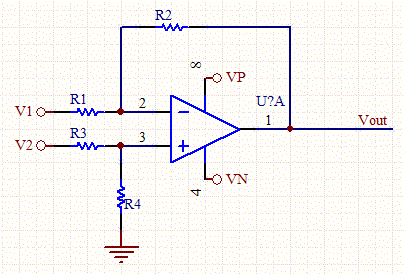
Calculate output voltage together with inverting and non-inverting gain for operational-amplifier circuits. Enter V1, V2, Vp, Vn, and resistor values R1 through R4 to obtain accurate results for circuit design, troubleshooting, and op-amp learning.
Input Parameters
Outputs
Introduction
Op Amp Gain | Details Calculations Formulas
OP AMP Calculator Overview
OP Amplifier calculator is an opamp calculation tool designed by Glofell, which is one of the best Electronic Components distributors. And with the help of this OP AMP Calculation tool, you can get the amplifier output power and Gain for an operational Amplifier. So OP AMP Calculator is also named OP AMP Gain Calculator (operational amplifier gain calculation tool) or OP AMP Voltage Calculator. And this OP AMP Calculator can work with not only inverting amplifier gain, but also non inverting amplifier gain. If you would like to calculate the values for differential amplifier, please refer to a differential amplifier calculator.
OP Amp Gain Formula
Maybe you have the question about how to calculate gain. The op amp equations are as the following:
And the above operational amplifier formulas are suitable for non inverting and inverting operational amplifier.
Inverting Op-Amp Gain
The op amp gain equation for an inverting op-amp is:
Non-Inverting Op-Amp Gain
The gain of the non inverting op-amp can be determined using the Operational Amplifier Formula for amp:
FAQ
Which input values are required by the calculator?
Enter the resistor values R1-R4 (in kΩ), input voltages V1 and V2 (in volts), and the supply voltages Vp and Vn (in volts). The tool uses these to determine output voltage and gain accurately.
What does the "Output is clipped" message mean?
This happens when the calculated Vout exceeds the supply voltages Vp or Vn. Since real op-amps cannot output beyond their supply rails, the signal is clipped at the rail voltage. Adjust input levels or resistor ratios to stay within supply limits.
How does the calculator determine inverting and non-inverting gain?
For the inverting configuration, gain = -R2/R1 (the negative sign reflects signal inversion). For the non-inverting configuration, gain = 1 + R2/R1. The resistor values you enter are plugged into these formulas.
Is this calculator suitable for differential amplifier circuits?
No. It is intended for basic inverting and non-inverting op-amp designs. For differential amplifier configurations, which use R3 and R4, please see a dedicated differential amplifier calculator because the gain formulas are different.
What causes the gain formulas to differ between inverting and non-inverting configurations?
In a non-inverting op-amp, the input is connected to the non-inverting terminal, so the gain remains positive: 1 + R2/R1. In an inverting op-amp, the input is applied to the inverting terminal through a resistor, which flips the phase and gives a negative gain: -R2/R1.
Related Tools

Resistor Color Code Calculator
106
Glofell’s Resistor Color Code Calculator decodes 4-band, 5-band, and 6-band resistors. Select each band to identify resistance, tolerance, and power rating for circuit work, repairs, or lab sorting.

Ohms Law Calculator
94
Glofell’s Ohm’s Law Calculator helps engineers and students quickly solve for voltage, current, resistance, and power. Provide any two known values to calculate the remaining parameters, making it a practical reference for circuit design, troubleshooting, and electronics learning.

Inverting Op-Amp Resistor Calculator
87
Analyze an inverting operational-amplifier circuit by entering the desired gain, output voltage (Vout), R1 resistance, and input voltages V1, V2, Vp, and Vn. The calculator automatically determines the required R2, R3, and R4 resistor values, helping you design and verify inverting op-amp configurations.

Switching Regulator Design Calculator
99
Design a switch-mode voltage regulator by calculating duty cycle, inductor value, current levels, and diode power loss. Use the results to optimize a DIY regulator circuit.