• open navigation menu
  • Logo
    • Input keywords/ Part number
    • Manufacturers
    • Hot Products
    • RFQ
    • Blog
    • Tools
    • About Us
    • Quality Control
    Logo

    Sale support

    • info@glofell.com

    Company

    • Blog
    • About Us
    • Quality Control
    • Contact Us

    Resource

    • Categories
    • Manufacturers
    • Tools

    Quick link

    • Privacy Policy
    • Terms & Conditions
    • Cookies Policy
    • Refund & Return Policy
    • Shipping & Delivery Policy

    © 2026 Copyright. All Rights Reserved. Made by Glofell

    Payment
    Payment
    Payment
    Payment
    1. Home/
    2. Tools/
    3. Current Divider Calculator

    Current Divider Calculator

    Glofell's Current Divider Calculator computes branch currents in parallel circuits using the current divider rule. Enter up to 10 resistor values for fast, reliable results.

    Current Divider Calculator

    R1
    =
    R2
    =
    R3
    =
    R4
    =
    Formula
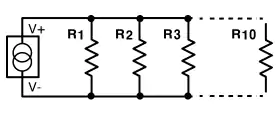
    R total= The total equivalent parallel resistance of the resistor array across the current source.
    Current divider diagram

    Introduction

    What is a Current Divider?

    Parallel circuits in which the source or supply current divides into a variety of parallel paths are known as current divider circuits. Both of the components in a parallel wired circuit have their terminals connected together and share the same two end nodes.

    Parallel circuits are distinguished by the fact that, although different currents can flow through different branches, the voltage is shared by all linked paths. VR1 = VR2 = VR3... and so on. As a result, finding individual resistor voltages is no longer necessary, and branch currents can be easily calculated using Kirchhoff's Current Law (KCL) and, of course, Ohm's Law.

    The current flowing through any branch of a parallel circuit can be calculated using this Current Divider Calculator.

    When a circuit is connected in parallel, the total current from the power source is divided among the circuit's branches depending on the resistance values of each branch. Since current follows the path of least resistance, more current will flow through branches with lower resistance, while less current will flow through a branch with high resistance.

    Mastering the Current Divider Calculator

    Understanding how current splits in a parallel circuit is essential for effective circuit design. Our calculator applies the standard Current Divider Rule to simplify this process for you.

    The Current Divider Formula

    To find the current flowing through a specific branch, we use the following equation:

    Ibranch=IS×RTotalRbranchI_{branch} = I_S \times \frac{R_{Total}}{R_{branch}}Ibranch​=IS​×

    Where:

    • IbranchI_{branch}Ibranch​: Current flowing through the specific branch.
    • ISI_SIS​: Total source current entering the node.
    • : Equivalent parallel resistance of the entire circuit.

    Step-by-Step Guide

    1. Input Data: Simply enter the total source current (ISI_SIS​) and the resistance values for each resistor in your parallel circuit.
    2. Automatic Calculation: The tool automatically computes the equivalent resistance and the resulting current for each individual branch.
    3. Variable Branches: Whether you are analyzing a simple 2-resistor circuit or a complex network, this tool is flexible. It supports 2 to 10 branches—just enter values for the active branches and leave the unused fields blank.

    The unit of this calculator's result is the one stated. Amperes (A), milliamperes (mA), or microamperes (A) may be used to express the resultant value.

    Rbranch​RTotal​​
    RTotalR_{Total}
    RTotal​
  • RbranchR_{branch}Rbranch​: Resistance of the specific branch you are measuring.
  • FAQ

    What is meant by current dividers?

    A current divider is a parallel circuit where the total current entering a node splits among multiple branches, each with the same voltage. Current division refers to using Kirchhoff's Current Law (KCL)—the sum of currents entering a node equals the sum leaving it—to calculate the individual branch currents.

    What is voltage and current divider rule?

    The current divider rule applies to parallel circuits, where the current divides among branches and the voltage across each branch is equal. It calculates the current through a given branch based on its resistance relative to the total parallel resistance. Similarly, the voltage divider rule applies to series circuits, where voltage divides according to resistance.

    What is voltage divider formula?

    A voltage divider uses two resistors in series to produce an output voltage that is a fraction of the input voltage. The formula is V_out = (R_b / (R_a + R_b)) × V_in, where R_a and R_b are the two series resistors and V_in is the supply voltage.

    How do I calculate current?

    Using Ohm's Law, current can be calculated as I = V ÷ R, where I is the current in amperes, V is the voltage in volts, and R is the resistance in ohms. For power, you can use P = V × I, which gives power in watts.

    Does a voltage divider affect current?

    Yes, a voltage divider affects current. The current drawn by the load must also flow through the series resistor, which can change the output voltage. Because of this, voltage dividers are not suitable for supplying power to loads; they work best for low-current reference signals.

    Is current divided in a parallel circuit?

    Yes. A parallel circuit has multiple paths for current to flow. The total current entering the circuit divides among these paths based on the resistance of each path—lower resistance receives more current, and higher resistance receives less.

    How do you calculate amps in a parallel circuit?

    In a parallel circuit, each branch has the same voltage, so you can calculate the current in each branch by dividing the supply voltage by that branch's resistance: I_branch = V / R_branch. The total current is the sum of all branch currents.

    What is the voltage divider equation?

    The voltage divider equation is V_out = V_in × (R2 / (R1 + R2)) for two series resistors R1 and R2. The output voltage is taken across R2, and the sum of the voltage drops across both resistors equals the supply voltage (Kirchhoff's Voltage Law).

    Can you measure current in parallel?

    To measure current, a multimeter must be connected in series with the branch so the current flows through it. Parallel-connected devices share the same voltage, but each may carry a different current, so measuring current in parallel would not give a meaningful reading.

    Related Tools
    Resistor Color Code Calculator

    Resistor Color Code Calculator

    106

    Glofell’s Resistor Color Code Calculator decodes 4-band, 5-band, and 6-band resistors. Select each band to identify resistance, tolerance, and power rating for circuit work, repairs, or lab sorting.

    Ohms Law Calculator

    Ohms Law Calculator

    94

    Glofell’s Ohm’s Law Calculator helps engineers and students quickly solve for voltage, current, resistance, and power. Provide any two known values to calculate the remaining parameters, making it a practical reference for circuit design, troubleshooting, and electronics learning.

    Op-Amp Voltage and Gain Calculator

    Op-Amp Voltage and Gain Calculator

    86

    Calculate output voltage together with inverting and non-inverting gain for operational-amplifier circuits. Enter V1, V2, Vp, Vn, and resistor values R1 through R4 to obtain accurate results for circuit design, troubleshooting, and op-amp learning.

    Inverting Op-Amp Resistor Calculator

    Inverting Op-Amp Resistor Calculator

    87

    Analyze an inverting operational-amplifier circuit by entering the desired gain, output voltage (Vout), R1 resistance, and input voltages V1, V2, Vp, and Vn. The calculator automatically determines the required R2, R3, and R4 resistor values, helping you design and verify inverting op-amp configurations.

    Hot Products
    02-N101-1
    02-N101-1
    Unknown
    HOT
    A03402
    A03402
    AOS
    HOT
    A4911KJPTR-T-1
    A4911KJPTR-T-1
    Allegro
    HOT
    ACS711ELCTR-12AB-T
    ACS711ELCTR-12AB-T
    Allegro
    HOT
    A333
    A333
    Allwinner
    HOT
    T113-S3
    T113-S3
    Allwinner
    NEW
    10M04SCU324C8G
    10M04SCU324C8G
    Altera
    NEW
    AD8656ARZ-REEL7
    AD8656ARZ-REEL7
    Analog Devices
    HOT
    ADA4932-1YCPZ-R7
    ADA4932-1YCPZ-R7
    Analog Devices
    HOT
    ADG453BRZ-REEL7
    ADG453BRZ-REEL7
    Analog Devices
    BEST SELL
    ACPL-P343-500E
    ACPL-P343-500E
    Broadcom
    HOT
    AEDR-8710-100
    AEDR-8710-100
    Broadcom